

Root of the Turnover Problem: The “Management Mismatch” Dilemma
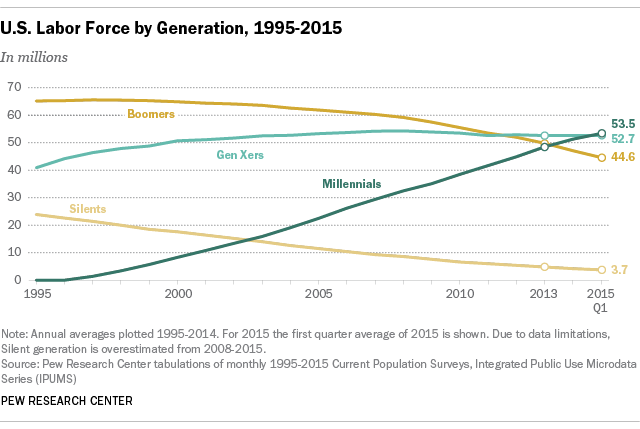
Millennials (1981-2000) are now the most prevalent generation in the workplace, comprising over 25%, surpassing the number of Baby Boomers (1946-1964) in 2014, and Generation X (1965-1980) in 2015. Traditionalists, or the Silent Generation (1900-1945) comprise roughly 3% of the workplace. Millennials are on track to comprise 50 percent of the workforce worldwide by 2020. This constitutes three, very different generations of employees in a single workplace.
This potpourri of generations creates a great challenge for managers. Each generations’ approach to work, work/life balance, employee loyalty, authority, and other important issues vary greatly.
| Millennials | Gen Xers | Baby Boomers |
|---|---|---|
| Want to be mentored in the workplace | Are independent and self-sufficient in the workplace | Believe in a hierarchal management structure and rankism |
| Are eager to share their knowledge, spirit, and energy | Tend to keep their heads down in the workplace | Are not afraid of confrontation |
| Expect more flexibility in the workplace, including time away from the office | Are often characterized as “slackers” | Are career-focused, often characterized as the “Workaholic Generation” |
| Are often motivated by a sense of purpose and belonging | Focus pretty much exclusively on “what can you do for me today?” | Are motivated by position, perks, and prestige |
| Have a limited ability to take criticism | Often demonstrate a fear of losing their jobs | Demonstrate great confidence in the workplace |
| Value individuality | Value time | Value success |
| Value contribution in the workplace | Value productivity in the workplace | Value long hours in the workplace |
| 19% of Millennials say most people can be trusted | 31% of Gen Xers say most people can be trusted | Tend not to trust anyone under 30 |
I’ve learned that people will forget what you said, people will forget what you did, but people will never forget how you made them feel.
After 20 years of research and 60,000 exit interviews, the Saratoga Institute reports that 80% of turnover is directly related to unsatisfactory relationships with one’s boss. According to a Gallup Organization study of approximately 1,000,000 workers, the number one reason people leave their jobs is because of “bad bosses”.
A manager in today’s law firms must be able to communicate with, assign work to, provide feedback, and otherwise lead their team in a manner unique to each generational group. The old “one-size-fits-all” management style of the Baby-Boomer days is no longer effective.
We believe that to gain a competitive edge, increase productivity, and decrease turnover, requires managers with high emotional intelligence, who can effectively manage these diverse generations. Emotionally intelligent managers more easily incorporate new measures and initiatives to increase the positive emotional attachment felt by their team. A team member’s emotional attachment towards their workplace, job role, position within the company, colleagues, and culture directly effects their feeling of well-being in their organization.
Research shows that managers with high emotional intelligence have a greater ability to keep these diverse generations engaged in the workplace. Gallup research clearly demonstrates that companies with a high level of engagement or almost total engagement will earn as much as 3.9 times the earnings (per share) than organizations who display lower or more inconsistent results.
Emotional intelligence is defined as the set of skills that allow us to perceive, understand and regulate our moods, and use emotional information to improve cognitive resources. The communication between our emotional and rational “brains” is the physical source of emotional intelligence. Effective managers demonstrate greater excellence in demonstrating the following six competencies than managers with lower emotional intelligence.
- Self-Awareness
- Awareness of Others
- Authenticity
- Emotional Reasoning
- Self-Management
- Positive Influence
SELF-AWARENESS is how aware we are of our feelings, and how those feelings impact our interactions with others. Managers who are self-aware, are more conscious are of how their feelings impact their personal interactions. Self-aware managers are said to be present, while less self-aware managers tend to be disconnected from their colleagues
AWARENESS OF OTHERS is how aware we of the feelings of those around us. Managers who demonstrate awareness of others are more empathetic towards their colleagues. Managers who demonstrate less awareness of others tend to be insensitive towards their colleagues.
AUTHENTICITY is how openly and effectively we express ourselves, and how well we honor our commitments. Managers who are authentic, are more genuine when providing feedback to their colleagues. On the other hand, Managers who are less authentic are viewed as untrustworthy by their colleagues, who in turn become less trustworthy.
EMOTIONAL REASONING is about how we consider our feelings and the feelings of those around us in our decision-making. Managers who combine this information with technical information and facts are more expansive in making decisions. Managers who neglect to consider feelings, tend to be more limited in their decision-making.
SELF-MANAGEMENT is how we manage our moods and feelings, and how we strive for self-improvement. When a Manager can manage their feelings and moods in the workplace, they tend to be more resilient, as do their colleagues. Managers who have a harder time managing their feelings and moods, are more temperamental, as will be their colleagues.
POSITIVE INFLUENCE is our ability to create a positive work environment by positively influencing the way others feel through problem solving, feedback, and recognizing and supporting the work of others. Managers who demonstrate a positive influence are empowering of their colleagues, who are then more easily motivated in their work. Managers who do not demonstrate a positive influence, tend to be indifferent in their work, as do their colleagues.
Unlike other metrics often used in manager selection, a manager can raise his or her emotional intelligence. If a manager is deficient in a particular competency, they can learn and hone skills for overcoming that deficiency, thereby increasing their emotional intelligence.